High-Vacuum, Thermal PVD System
High-Vacuum, Thermal PVD System
High-Vacuum, Thermal PVD System
Creating a configurable, water-cooled, metal-melting, physical vapor deposition (PVD) system in my bedroom.
Creating a configurable, water-cooled, metal-melting, physical vapor deposition (PVD) system in my bedroom.
Background
Background
Background
In industry, physical vapor deposition systems can be implemented using many different techniques and phenomena, but they all operate on the same fundamentals. When a metal is brought into a free flight state (either by ion bombardment or vaporization) inside a vacuum, that metal will fly unimpeded until it strikes a surface. The metal will then deposit onto that surface in potentially atomically-thick layers. This technique allows you to deposit very thin layers of metals (or some non-metals) onto a different part or surface, and is critical to processes such as computer chip making and optics coatings.
This project was initially inspired by this same phenomena occurring in my graduate research's laser welding vacuum chamber. Metal melted and vaporized by the laser would be immediately deposited onto all visible surfaces. While this is a huge issue when trying to maintain clear optics for a >1kW laser, I found the idea fascinating.
Two designs were considered for this project: a magnetron sputterer and a thermal PVD system. Magnetron sputtering systems use high voltage to ionize a gas which is then constrained by magnetic fields to the donor surface. The highly energetic ionized gas will "knock off" atoms of the donor surface (often a metal) which will fly and deposit onto visible surfaces. This is highly controllable by gas flow, voltage, current, etc but is somewhat complicated to build.
In contrast, thermal PVD systems simply melt and vaporize metals to re-deposit on visible surfaces. This is theoretically more simple to build but has its own drawbacks such as high currents and heat. This type of PVD system was chosen for this project due to the simplicity, though a true magentron sputterer is currently being designed.
In industry, physical vapor deposition systems can be implemented using many different techniques and phenomena, but they all operate on the same fundamentals. When a metal is brought into a free flight state (either by ion bombardment or vaporization) inside a vacuum, that metal will fly unimpeded until it strikes a surface. The metal will then deposit onto that surface in potentially atomically-thick layers. This technique allows you to deposit very thin layers of metals (or some non-metals) onto a different part or surface, and is critical to processes such as computer chip making and optics coatings.
This project was initially inspired by this same phenomena occurring in my graduate research's laser welding vacuum chamber. Metal melted and vaporized by the laser would be immediately deposited onto all visible surfaces. While this is a huge issue when trying to maintain clear optics for a >1kW laser, I found the idea fascinating.
Two designs were considered for this project: a magnetron sputterer and a thermal PVD system. Magnetron sputtering systems use high voltage to ionize a gas which is then constrained by magnetic fields to the donor surface. The highly energetic ionized gas will "knock off" atoms of the donor surface (often a metal) which will fly and deposit onto visible surfaces. This is highly controllable by gas flow, voltage, current, etc but is somewhat complicated to build.
In contrast, thermal PVD systems simply melt and vaporize metals to re-deposit on visible surfaces. This is theoretically more simple to build but has its own drawbacks such as high currents and heat. This type of PVD system was chosen for this project due to the simplicity, though a true magentron sputterer is currently being designed.
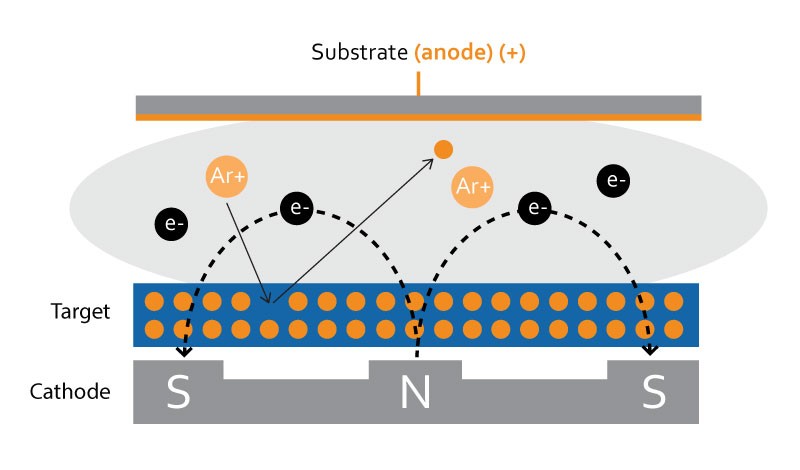
Magnetron Sputtering
Image: Denton Vacuum
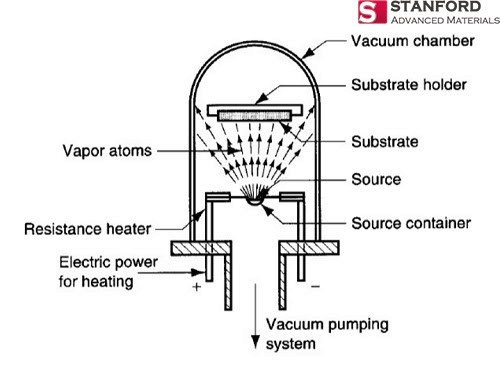
Thermal Evaporation
Image: SAM Sputter Targets
Design Choices
Design Choices
Design Choices
With the theory in mind, I could start coming up with constraints to guide the design.
The first consideration would be how to actually melt metal inside the chamber. Industrial systems often use a tungsten boat as these allow you to melt nearly any metal without damaging the tungsten itself. After some searching, I found a supplier for cheap 14mm x 60mm tungsten boats to use in the system.
In order to pass current through this boat, I would need a fixture that could withstand the extreme temperatures. I did not want to risk melting my electrodes or be limited by run time so early on decided that I would build a water cooling system for the jaws. This would be quite the challenge as I had to get pressurized water into and out of the chamber without leaking into the vacuum system.
With these constraints, I completed the design of the system. The full system was built as a unit mounted to the top ISO160 flange such that it could simply be slid in and out of the vacuum chamber body. This allowed me to easily make modifications to the PVD system or remove it without modifying the rest of the chamber.
The flange started as an ISO160-to-KF-16 adapter but underwent major changes. Two additional KF-16 ports were welded into the flange to fit the two high-current feedthroughs. Additional stainless hose barbs were welded through the flange to allow coolant in and out. The central port is currently used for the vacuum gauge, but is planned to eventually be used as a port for custom rotary feedthrough. This will allow me to "shutter" the sputtering or rotate/move the part being coated.
The electrode assembly is the most complex assembly of the project and is discussed below.
With the theory in mind, I could start coming up with constraints to guide the design.
The first consideration would be how to actually melt metal inside the chamber. Industrial systems often use a tungsten boat as these allow you to melt nearly any metal without damaging the tungsten itself. After some searching, I found a supplier for cheap 14mm x 60mm tungsten boats to use in the system.
In order to pass current through this boat, I would need a fixture that could withstand the extreme temperatures. I did not want to risk melting my electrodes or be limited by run time so early on decided that I would build a water cooling system for the jaws. This would be quite the challenge as I had to get pressurized water into and out of the chamber without leaking into the vacuum system.
With these constraints, I completed the design of the system. The full system was built as a unit mounted to the top ISO160 flange such that it could simply be slid in and out of the vacuum chamber body. This allowed me to easily make modifications to the PVD system or remove it without modifying the rest of the chamber.
The flange started as an ISO160-to-KF-16 adapter but underwent major changes. Two additional KF-16 ports were welded into the flange to fit the two high-current feedthroughs. Additional stainless hose barbs were welded through the flange to allow coolant in and out. The central port is currently used for the vacuum gauge, but is planned to eventually be used as a port for custom rotary feedthrough. This will allow me to "shutter" the sputtering or rotate/move the part being coated.
The electrode assembly is the most complex assembly of the project and is discussed below.
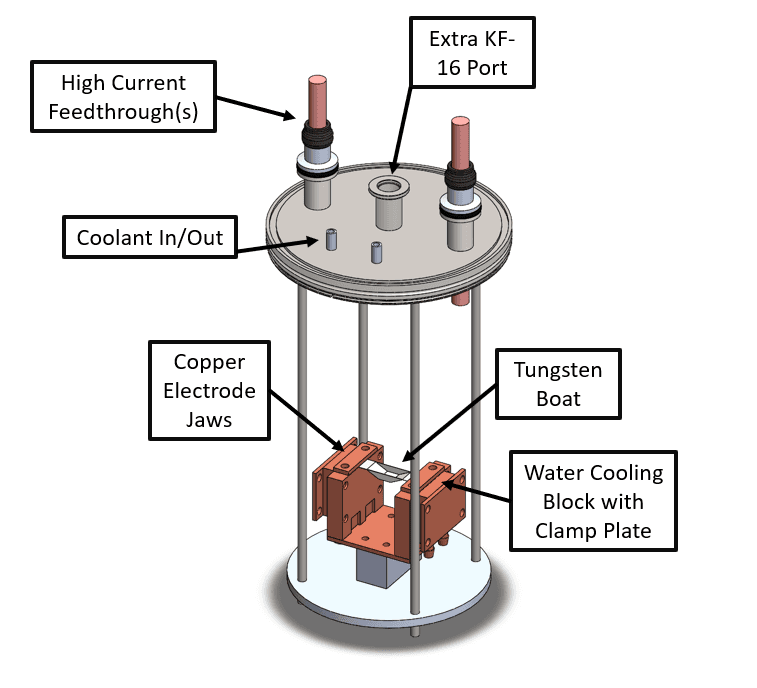
Diagram of PVD assembly
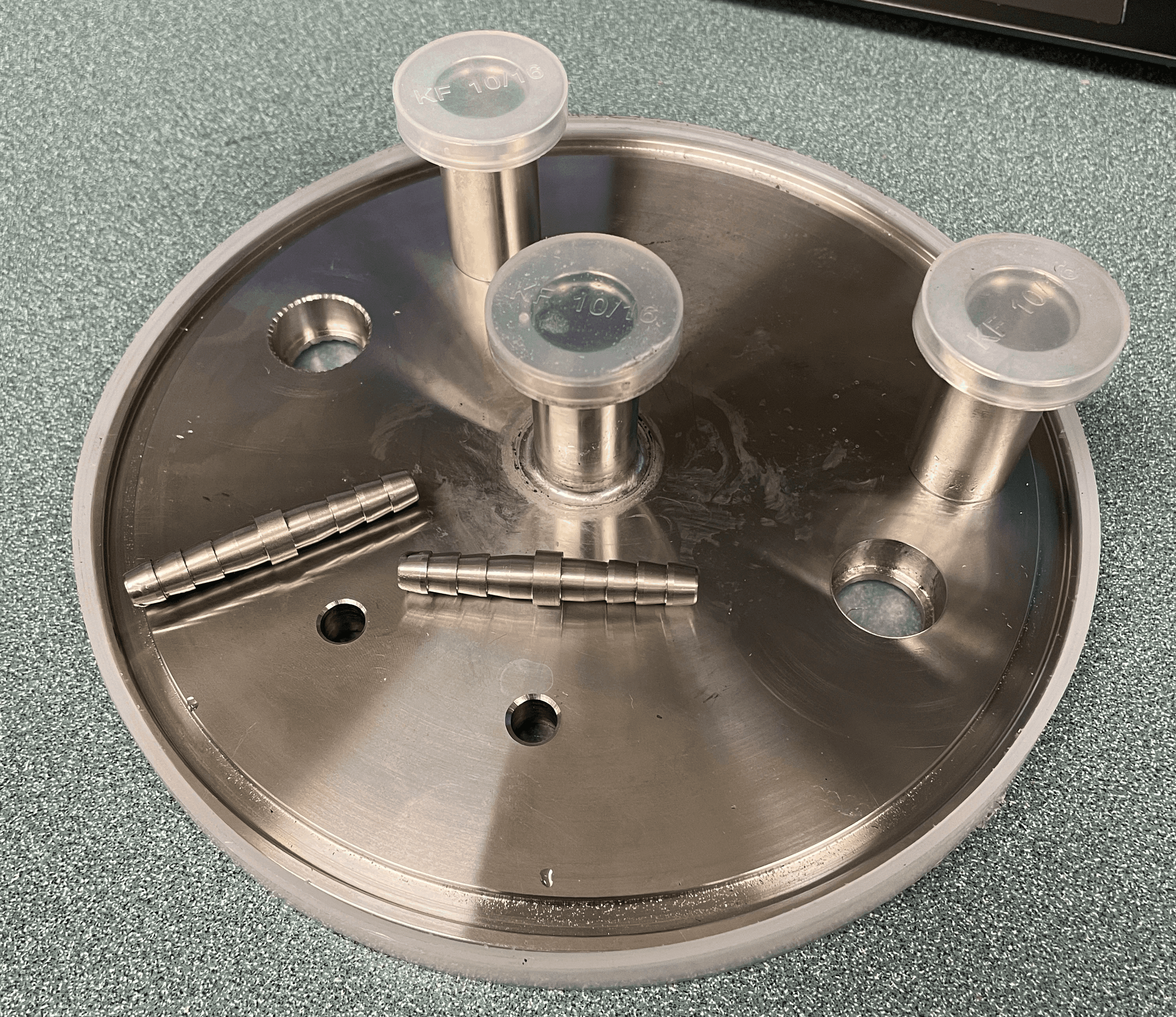
Primary PVD flange pre-welding
Electrode Assembly
Electrode Assembly
Electrode Assembly
A few important constraints guided the design of the electrode assembly:
The jaws needed to firmly clamp onto the tungsten boat.
There should be a short thermal path through solid metal from the tungsten boat to the water blocks.
The two jaws needed to be electrically isolated but still rigidly mounted to a connection plate.
Nothing can deteriorate or melt under the extreme light irradiation.
Ideally, the jaws should be flexible so that different sizes of boat could be used.
The result of these constraints is the design below. The two electrodes are identical and mirrored across the centerline. Each electrode has a primary body that attaches the tungsten boat via a clamp plate on the top, the water block via a clamp plate on the back, and the mounting plate on the bottom. All parts were made out of (scrap) copper where possible for a high thermal mass and conductivity.
To achieve electrical isolation during assembly, two different insulators were required. A PTFE sheet is used to prevent the body from contacting the electrode mounting plate directly. To prevent the bolt from shorting to the mounting plate, custom PTFE bushings are used to isolate the bolt.
The heating is powered by a salvaged microwave oven transformer with a secondary rewired for low voltage, but very high currents. With approximately 3 windings on the secondary, it produces 4 VAC with theoretical maximum currents up to 450A on a 1500W breaker.
A few important constraints guided the design of the electrode assembly:
The jaws needed to firmly clamp onto the tungsten boat.
There should be a short thermal path through solid metal from the tungsten boat to the water blocks.
The two jaws needed to be electrically isolated but still rigidly mounted to a connection plate.
Nothing can deteriorate or melt under the extreme light irradiation.
Ideally, the jaws should be flexible so that different sizes of boat could be used.
The result of these constraints is the design below. The two electrodes are identical and mirrored across the centerline. Each electrode has a primary body that attaches the tungsten boat via a clamp plate on the top, the water block via a clamp plate on the back, and the mounting plate on the bottom. All parts were made out of (scrap) copper where possible for a high thermal mass and conductivity.
To achieve electrical isolation during assembly, two different insulators were required. A PTFE sheet is used to prevent the body from contacting the electrode mounting plate directly. To prevent the bolt from shorting to the mounting plate, custom PTFE bushings are used to isolate the bolt.
The heating is powered by a salvaged microwave oven transformer with a secondary rewired for low voltage, but very high currents. With approximately 3 windings on the secondary, it produces 4 VAC with theoretical maximum currents up to 450A on a 1500W breaker.
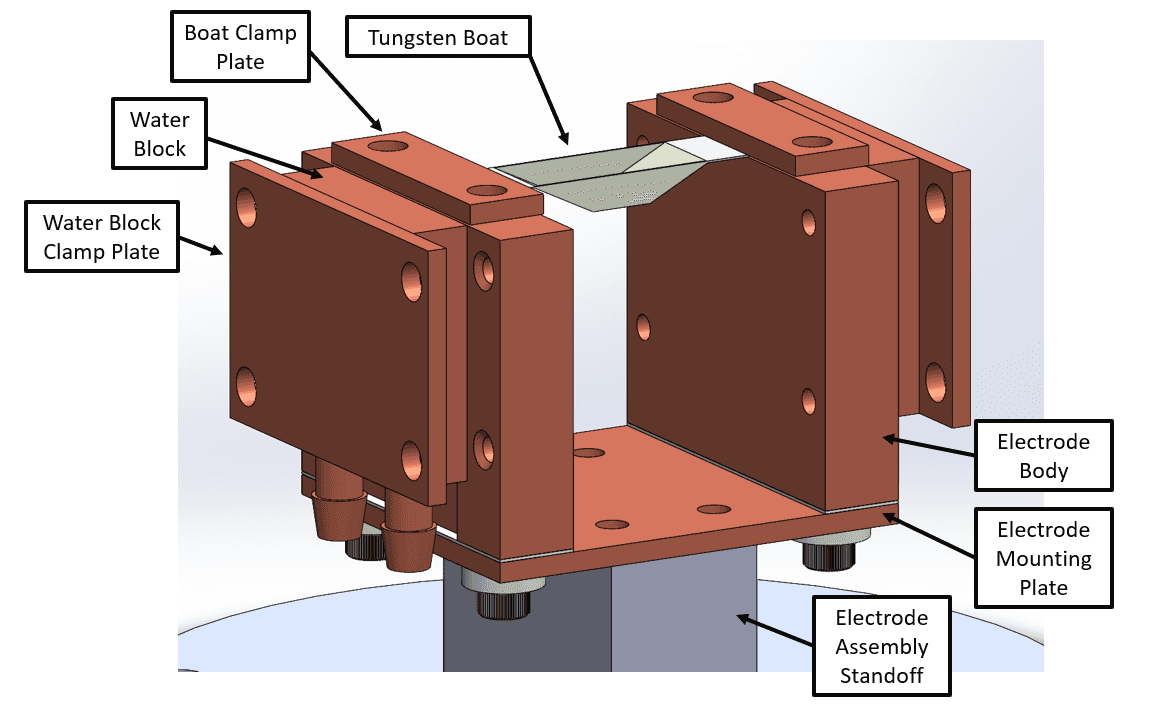
Diagram of electrodes
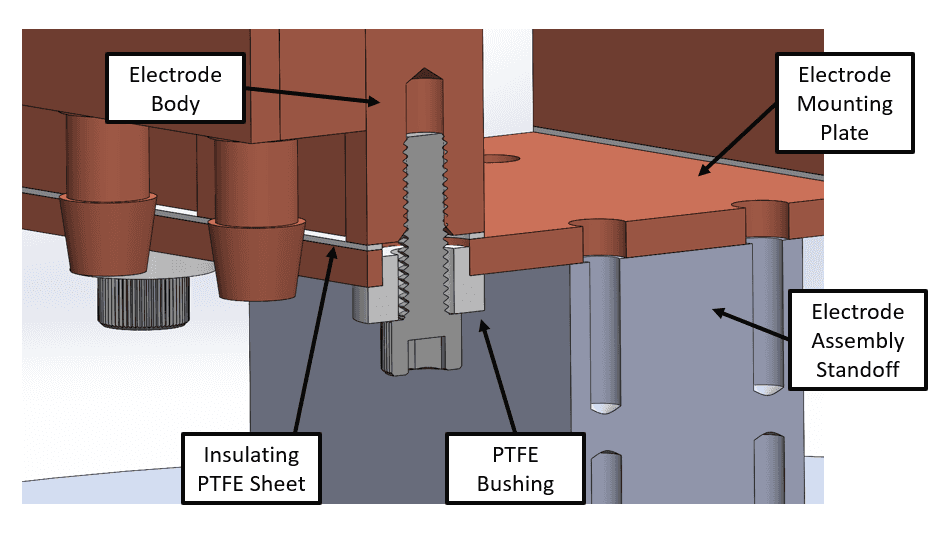
Diagram of electrode insulation
Initial Tests
Initial Tests
Initial Tests
A small amount of copper was added to the boat which was very quickly melted. Unfortunately, it wetted well enough that attempts to remove the ball broke the tungsten boat.
A small amount of copper was added to the boat which was very quickly melted. Unfortunately, it wetted well enough that attempts to remove the ball broke the tungsten boat.
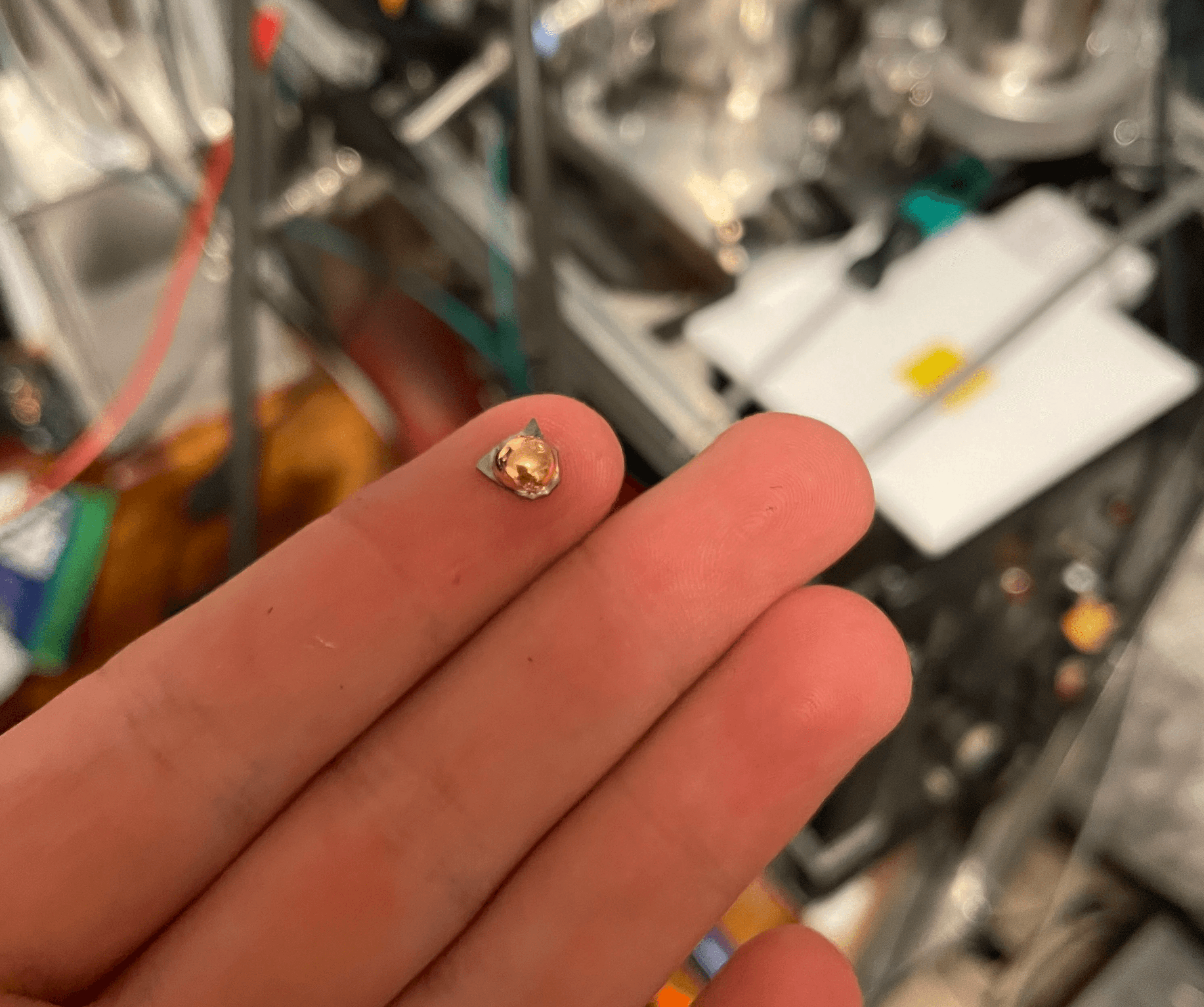
First melted metal with PVD system
Copper melting inside boat
The next test showed a significant increase in the amount of copper in the boat. This copper was very quickly melted and allowed to sit above its melting point for <30 seconds. However, too much had been added. An oscillatory motion formed due to the pool's size, creating a path with much lower resistance than the boat's. This would create cold spots, causing the copper to move to that region, and the process would repeat continuously. Eventually, the pool of copper moved around the side of the boat and onto the bottom of the boat. In this position, with such close proximity to solid surfaces, it very rapidly formed a thick deposition layer that flaked off into copper foil. The result of this test is below.
The next test showed a significant increase in the amount of copper in the boat. This copper was very quickly melted and allowed to sit above its melting point for <30 seconds. However, too much had been added. An oscillatory motion formed due to the pool's size, creating a path with much lower resistance than the boat's. This would create cold spots, causing the copper to move to that region, and the process would repeat continuously. Eventually, the pool of copper moved around the side of the boat and onto the bottom of the boat. In this position, with such close proximity to solid surfaces, it very rapidly formed a thick deposition layer that flaked off into copper foil. The result of this test is below.
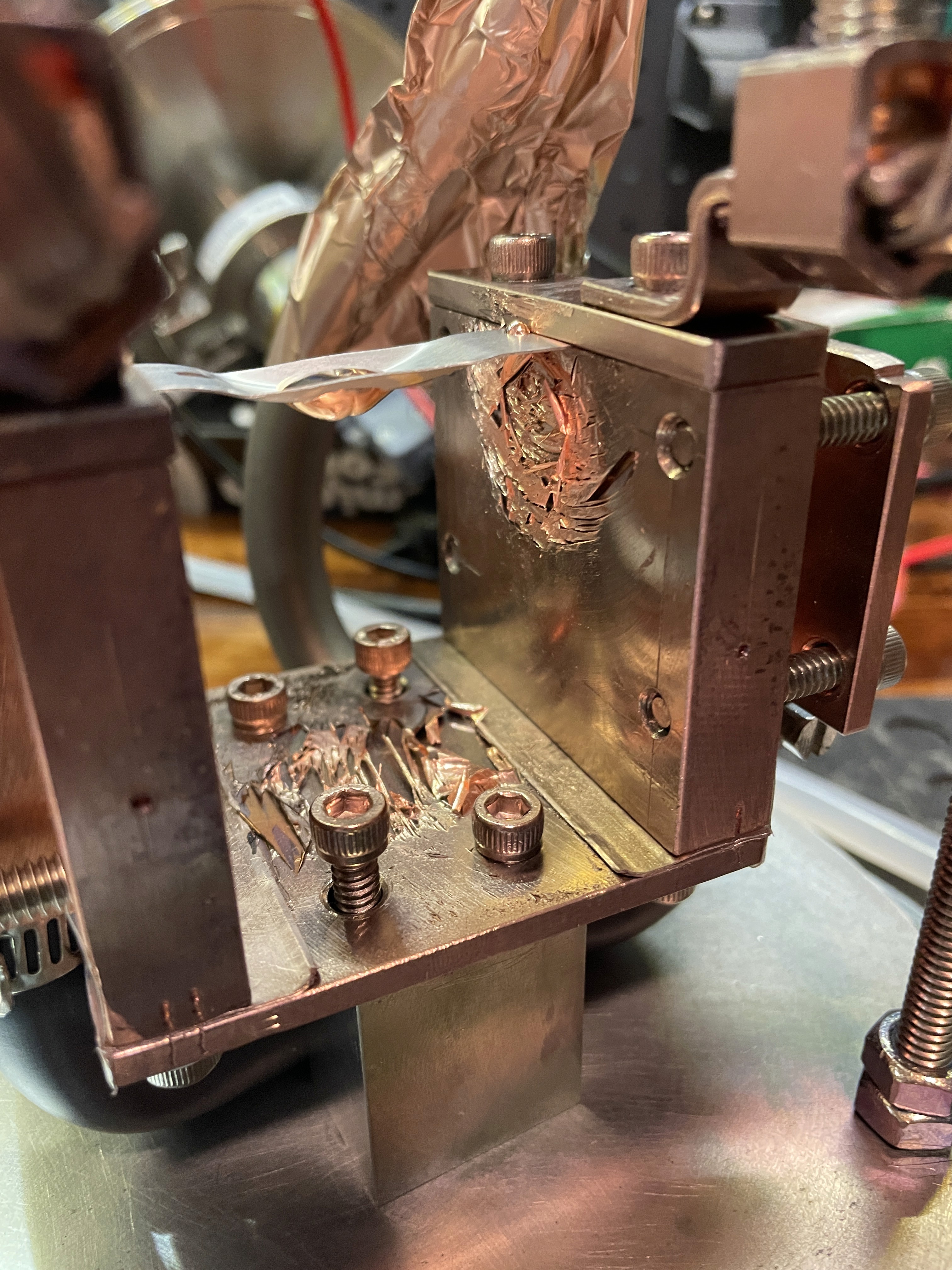
Extreme deposition on the copper jaws.
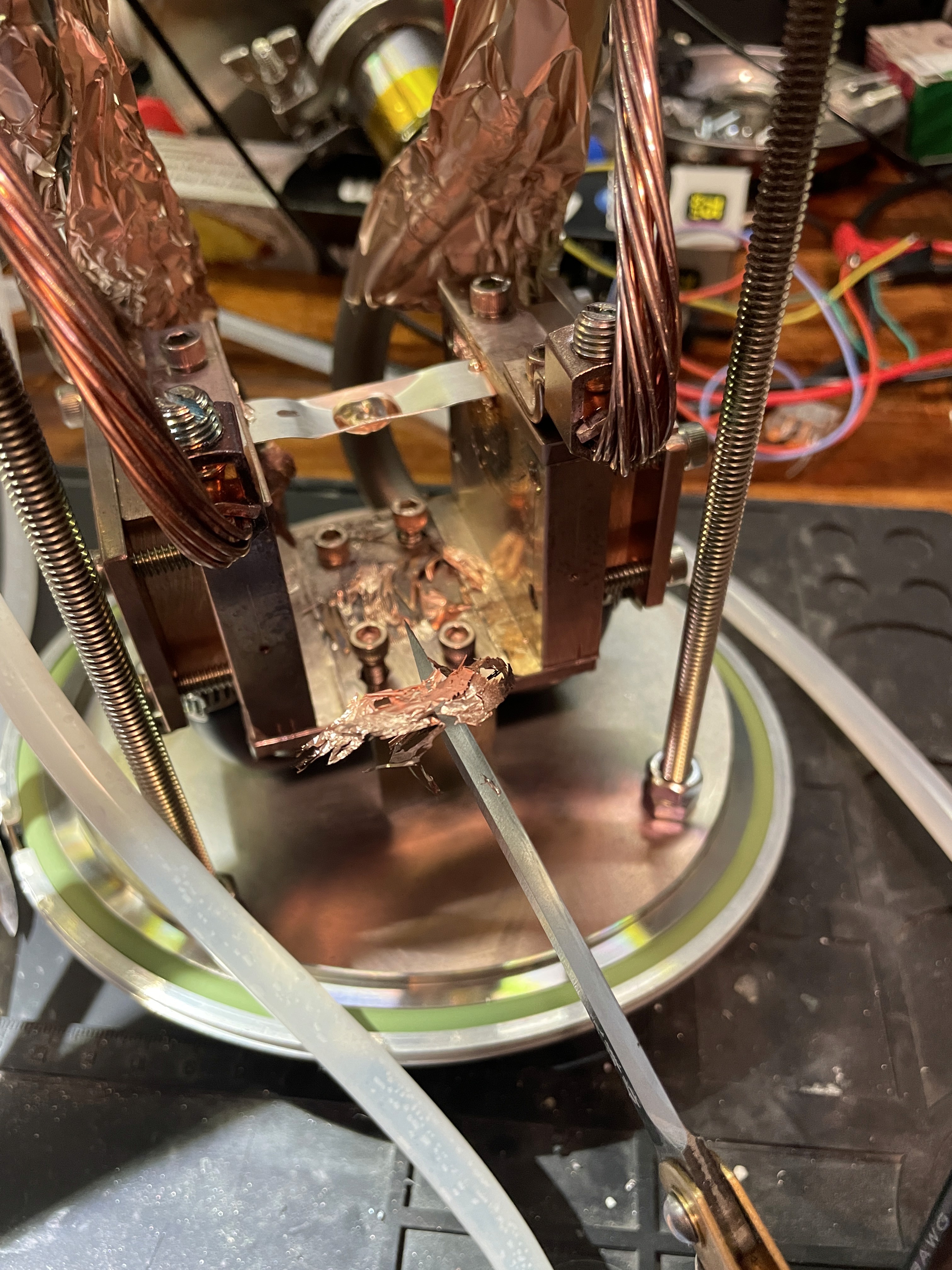
Deposited foil. Thin enough to float away at the smallest breeze.
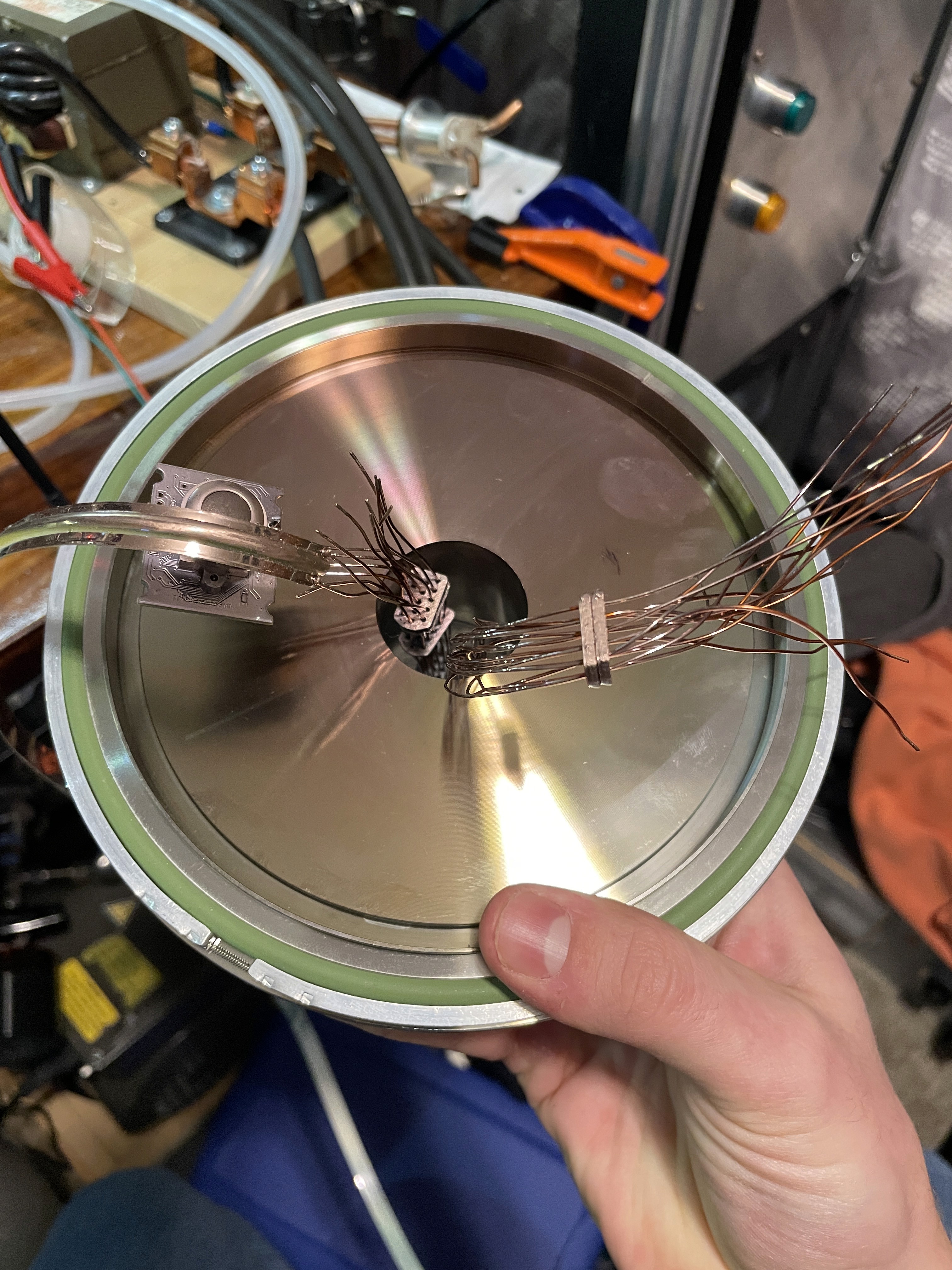
Unintentional deposition on an internal camera and light.
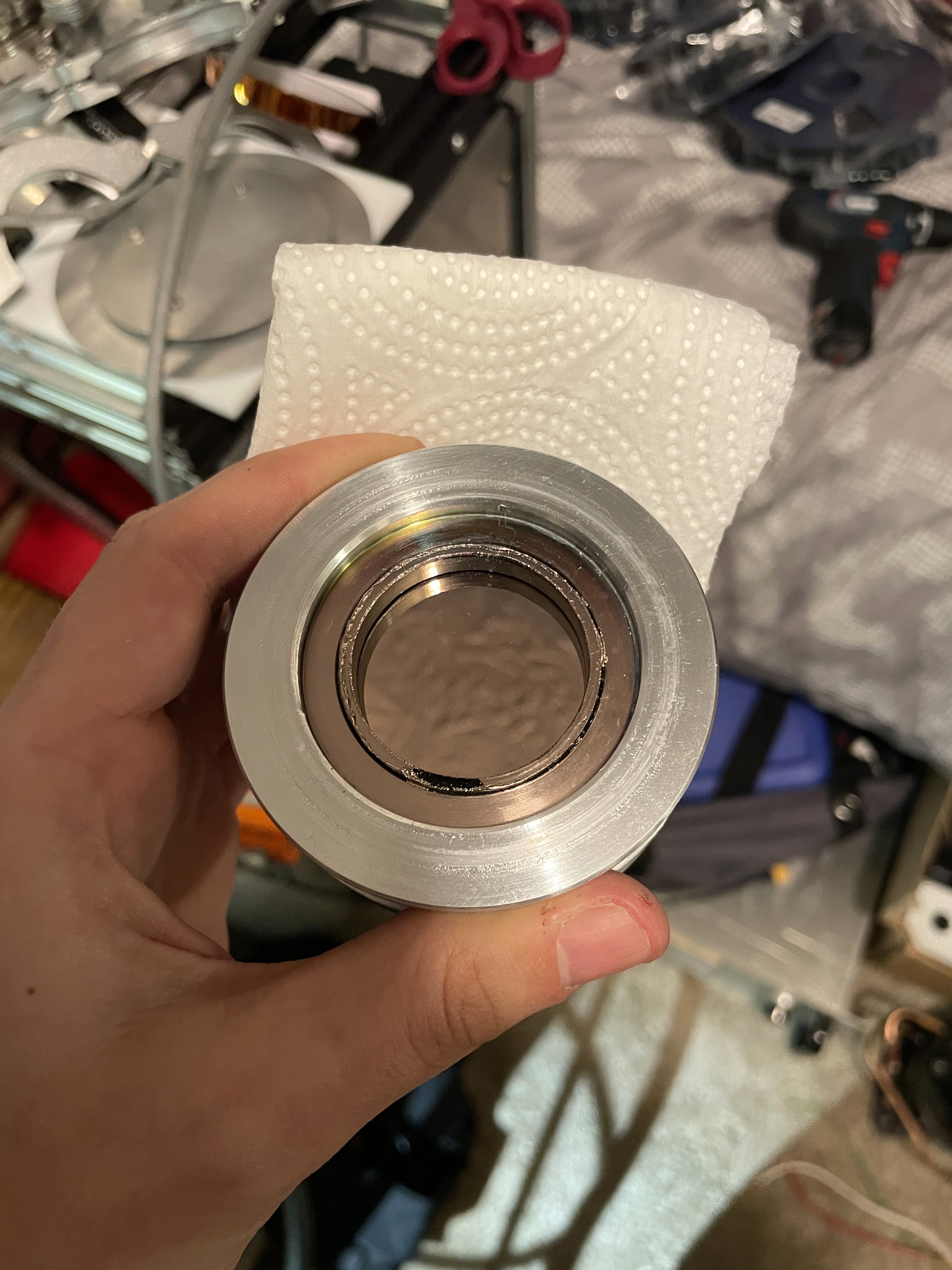
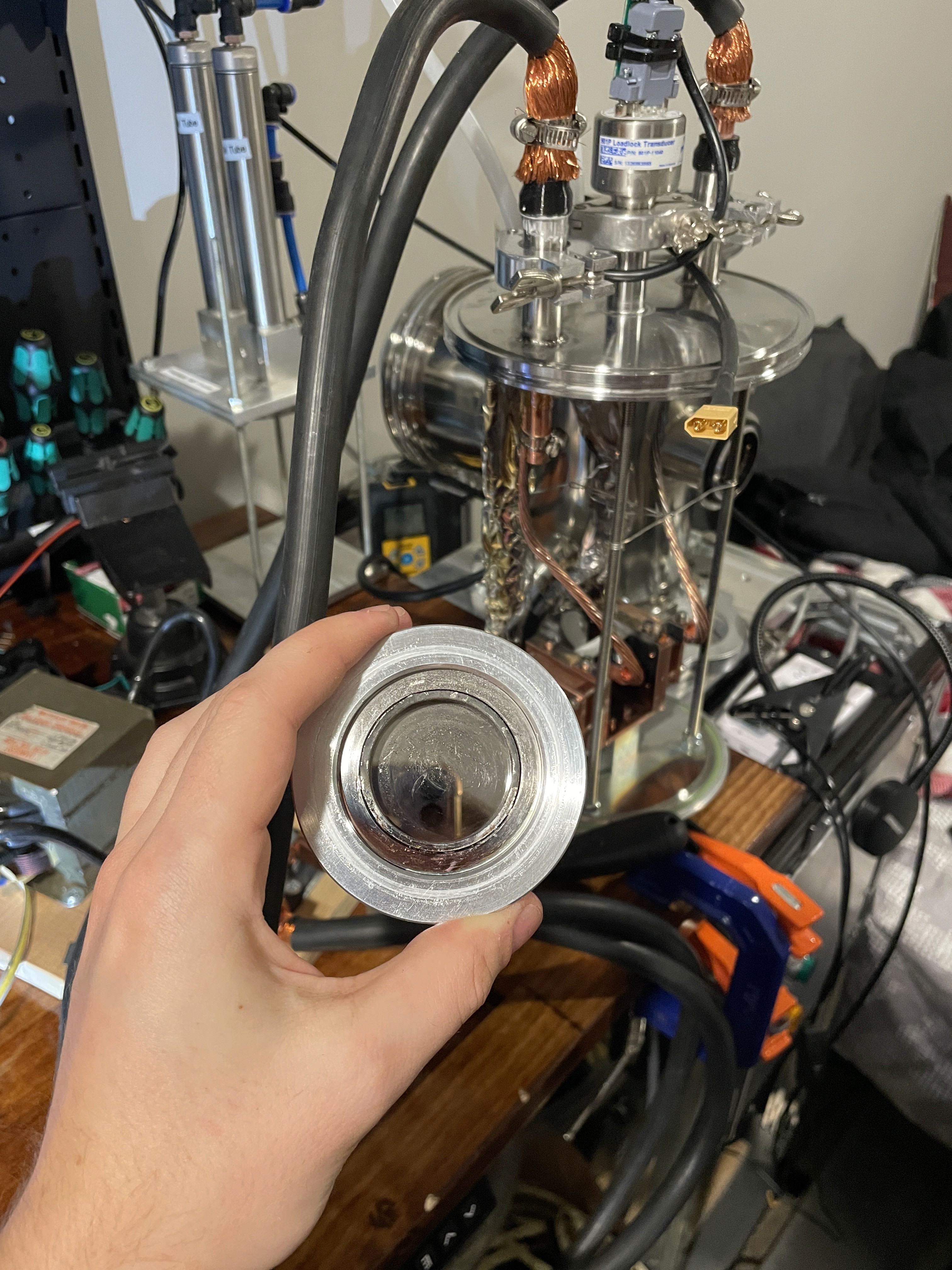
Very consistent layer left on viewing window glass.
With the lesson learned to minimize melt pool volume, the next test used a small piece of commerical pure nickel (melting point ~1450 deg C). This also effectively deposited on multiple surfaces in the chamber.
With the lesson learned to minimize melt pool volume, the next test used a small piece of commerical pure nickel (melting point ~1450 deg C). This also effectively deposited on multiple surfaces in the chamber.
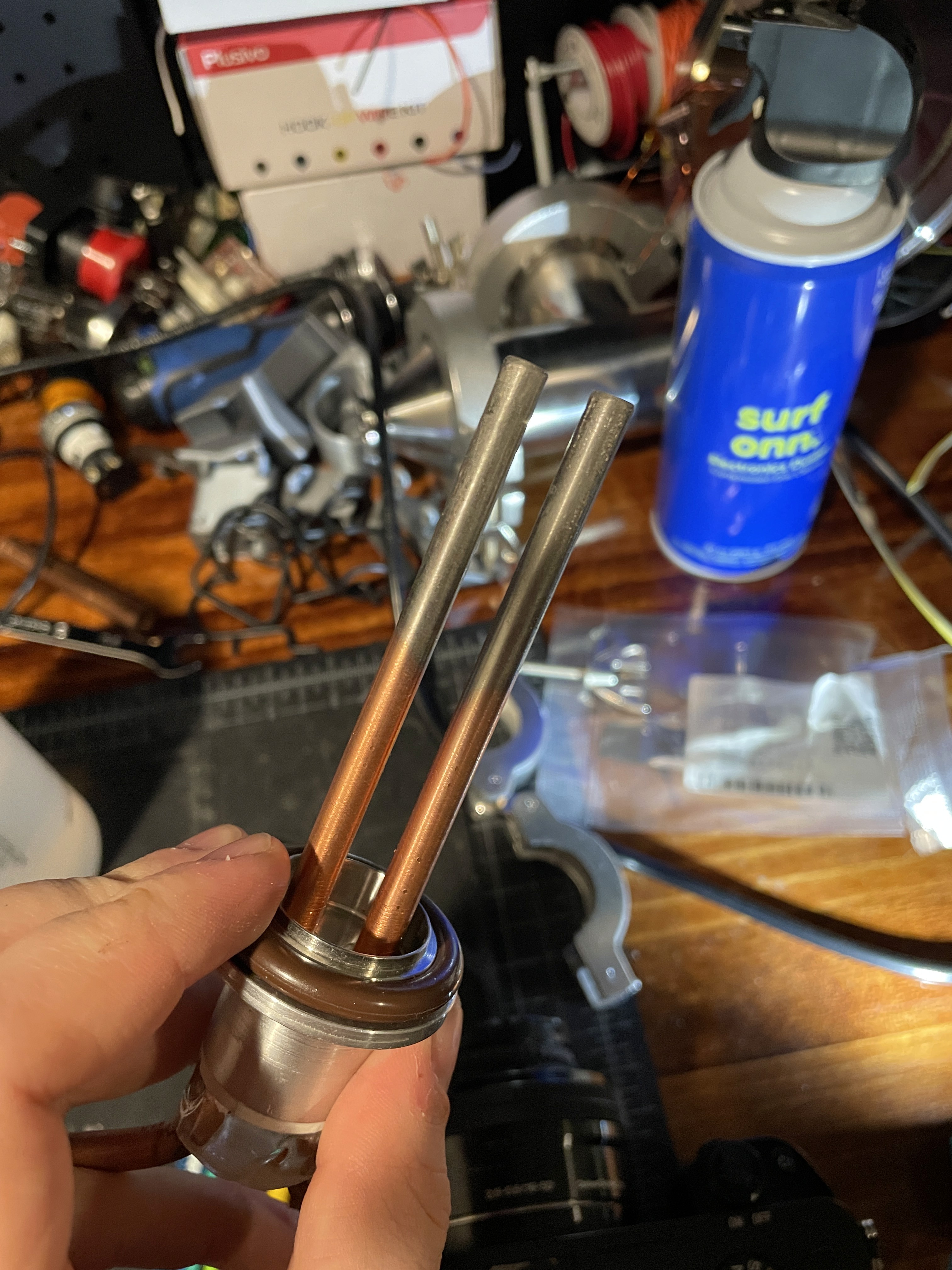
Nickel on copper.
Nickel layer on glass
End Result
End Result
End Result
As shown above, this PVD system works extremely well for rapid melting and deposition of metals. Copper and Nickel have so far been tested, but with those temperatures proven, most common metals could be deposited with this system.
Future work involves a shutter system to control deposition more accurately, a method of moving samples to more consistently coat them, and a variac/triac system to accurately tune the boat's temperature.
As shown above, this PVD system works extremely well for rapid melting and deposition of metals. Copper and Nickel have so far been tested, but with those temperatures proven, most common metals could be deposited with this system.
Future work involves a shutter system to control deposition more accurately, a method of moving samples to more consistently coat them, and a variac/triac system to accurately tune the boat's temperature.